I love to read the stories of immigrants who came to America with little but a set of skills, and a dream of the opportunity to use them to create a new future. Indeed, most of us are descendants of immigrants, with our own fascinating stories in our family trees. My great-great-grandfather, Christian Frederick Mueller, was schooled in the Black Forest of Germany and trained as a baker. He immigrated to America in 1866, at the age of 27. With only a recipe and a three-wheeled pushcart, he began a business selling hand-made noodles from house to house, billing them with the slogan, “As a change from potatoes.” By the time Christian handed the business on to his three sons in 1915, his factory covered four acres and had its own power plant, railroad siding and fleet of trucks to transport Mueller’s pasta near and far. This may be one reason why I was intrigued and touched by the story we learned of the little Mississippi River town of Muscatine, Iowa and the man who made it famous throughout the world.
"From Germany he comes, in Iowa he settles,
button-making skills and tools his luggage,
intention and hope his companions."
- excerpt from "Pearl Buttons,"
  a tribute to craftsman, John Boepple
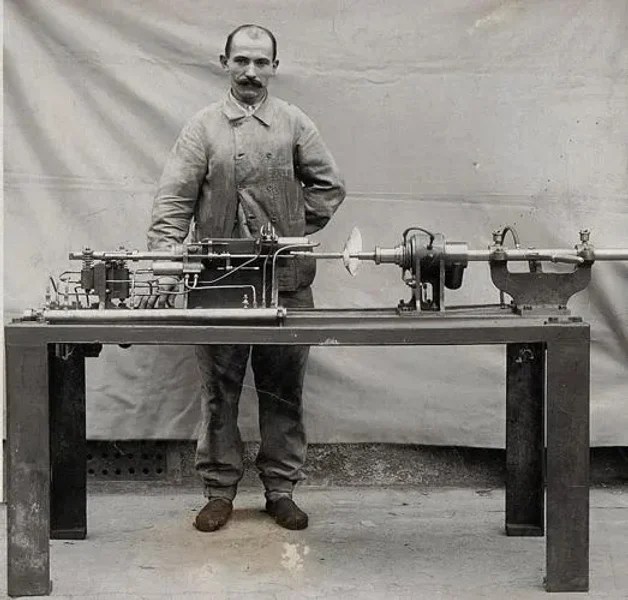
John Frederick Boepple made buttons from ocean shells, horns and antlers for the family business in Germany. When tariffs threatened the profits. he immigrated to America in search of shells like the ones his father had been sent from an area near Chicago. He finally found mussels with the thick, iridescent nacre he wanted. He settled in Muscatine, Iowa, where he and financial partner, William Molis, opened the Boepple Button Factory, the world’s first pearl button plant. Photo from http://www.notesonIowa.com
Over the next several years, Boepple updated the technology used in his manufacturing process and the business flourished. The success of this first plant, a plentiful supply of mussels, and a worldwide market for the lustrous buttons created a perfect environment for the industry to expand. By 1897, 300 “clammers” harvested over 3500 pounds of mussels from the river each year to supply 53 button-making shops in Muscatine alone. And by the early 1900’s, Muscatine produced 1.5 billion mother of pearl buttons each year, achieving fame as the Pearl Button Capital of the World.
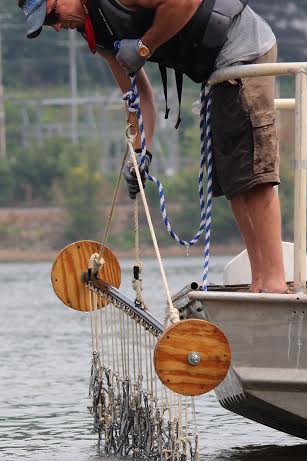
John Boepple could no longer compete with the industry he created. He took a job selling shells to other companies, but worried about the detrimental effects of over-harvesting. In 1910, he began to work at the Fairport Biological Station, a research facility of the Bureau of Fisheries created by Congress two years earlier. There, Boepple helped to study the breeding of mussels and develop sustainable harvesting techniques.
Photo by Constancia Roling, showing Mississippi River clamming, 2013
Thanks for stopping by to hear about John Boepple and read a snippet of the poem I wrote as a tribute to him. His story was irresistible and begged to be told through a poem. In fact, this poem nearly wrote itself. I hope you can glean some inspiration from the story in either of its forms. Next week, I’ll share the story of a mishap Gene and I encountered in a stump field. Although it wasn’t very funny at the time, it’s gotten more so in the retelling. It’s also perfect material for a humorous poem in the rhyming style of one of my favorite children’s poets, Shel Silverstein! You won’t want to miss “Stuck on a Stump!” Gratefully yours, Barb
 Author Barb Geiger